Override
.override(**kwargs) is ferrum's escape hatch for the rare case where the typed
configuration surface hasn't caught up to what you need. It lets you inject
spec-path key/value pairs directly into the chart spec at render time.
When to use override
Override is explicitly a last resort. Before reaching for it, check whether the typed surface covers your need:
| Need | Typed surface |
|---|---|
| Rotate axis labels | .configure_axis(label_angle=...) |
| Change tick count | .configure_axis(tick_count=...) |
| Move legend | .configure_legend(orient=...) |
| Adjust title alignment | .configure_title(anchor=...) |
| Show/hide grid | .configure_grid(x=..., y=...) |
| Set padding | .configure_padding(...) |
Use override only when you need to set something that the typed surface doesn't yet expose. Override should be a temporary measure; if you find yourself using it for the same thing repeatedly, that's a signal that the typed surface has a gap worth reporting.
Path conventions
Override paths use snake_case with underscores to separate the spec hierarchy:
# axis settings
chart.override(
    x_axis_label_angle=-45,
    y_axis_tick_count=6,
    y_axis_grid_color="#eee",
)

# legend settings
chart.override(
    legend_orient="bottom",
)

# mark settings
chart.override(
    mark_opacity=0.8,
)
Scope
Override reaches the chart's presentation spec: the chart-level config
(x_axis_*/y_axis_*, legend_*, title_*, grid_*, padding_*, color_*),
per-channel scales (<channel>_scale_*, e.g. x_scale_domain), mark style
(mark_*), coordinate settings (coord_*), and width/height. It does not
set structural grammar — mark type, encoding field bindings, transforms, or
faceting — those belong to the typed grammar API.
Per-channel axis=/legend= options set on an encoding (e.g.
fm.X("f", axis={...})) are not override targets; a <channel>_axis_* /
<channel>_legend_* path raises FerrumOverrideError. Use the typed chart-config
paths (x_axis_*, legend_*) instead — they cover the same settings and are
validated against the typed surface.
Validation at render time
Unknown override paths raise FerrumOverrideError when the chart renders, not when
.override() is called. The error message includes the invalid path and a list of
closest matches:
FerrumOverrideError: Unknown override path 'x_axis_lable_angle'.
Did you mean: 'x_axis_label_angle'?
This means override calls are syntactically valid Python even with typos, but you will see the error when you first render or save the chart.
Deprecation warnings
Some override paths have typed equivalents in the current API. Using these paths emits a
DeprecationWarning at render time that points to the correct method:
DeprecationWarning: override path 'legend_orient' has a typed equivalent:
  .configure_legend(orient=...)
Use the typed method instead.
The override still applies even when the warning fires, so existing code continues to work. Migrate to the typed method at your convenience.
Multiple override calls
Multiple .override() calls merge their kwargs. Later calls win on key conflicts:
chart = (
    fm.Chart(df)
    .mark_point()
    .encode(x="x:Q", y="y:Q")
    .override(x_axis_label_angle=-30)
    .override(x_axis_label_angle=-45)  # wins; applied angle is -45
)
This is consistent with how configure_*() layers stack — later always wins within the
same key.
Override in the cascade
Override sits at the top of the six-level cascade: it beats per-channel axis=,
chart-level configure, themes, and Rust defaults.
1. chart.override(...)           ← wins everything
2. Per-channel axis= / legend=
3. chart.configure_*()
4. chart.theme(...)
5. set_default_theme(...)
6. Rust renderer defaults
A value set via override cannot be overridden by anything else. Use that power judiciously.
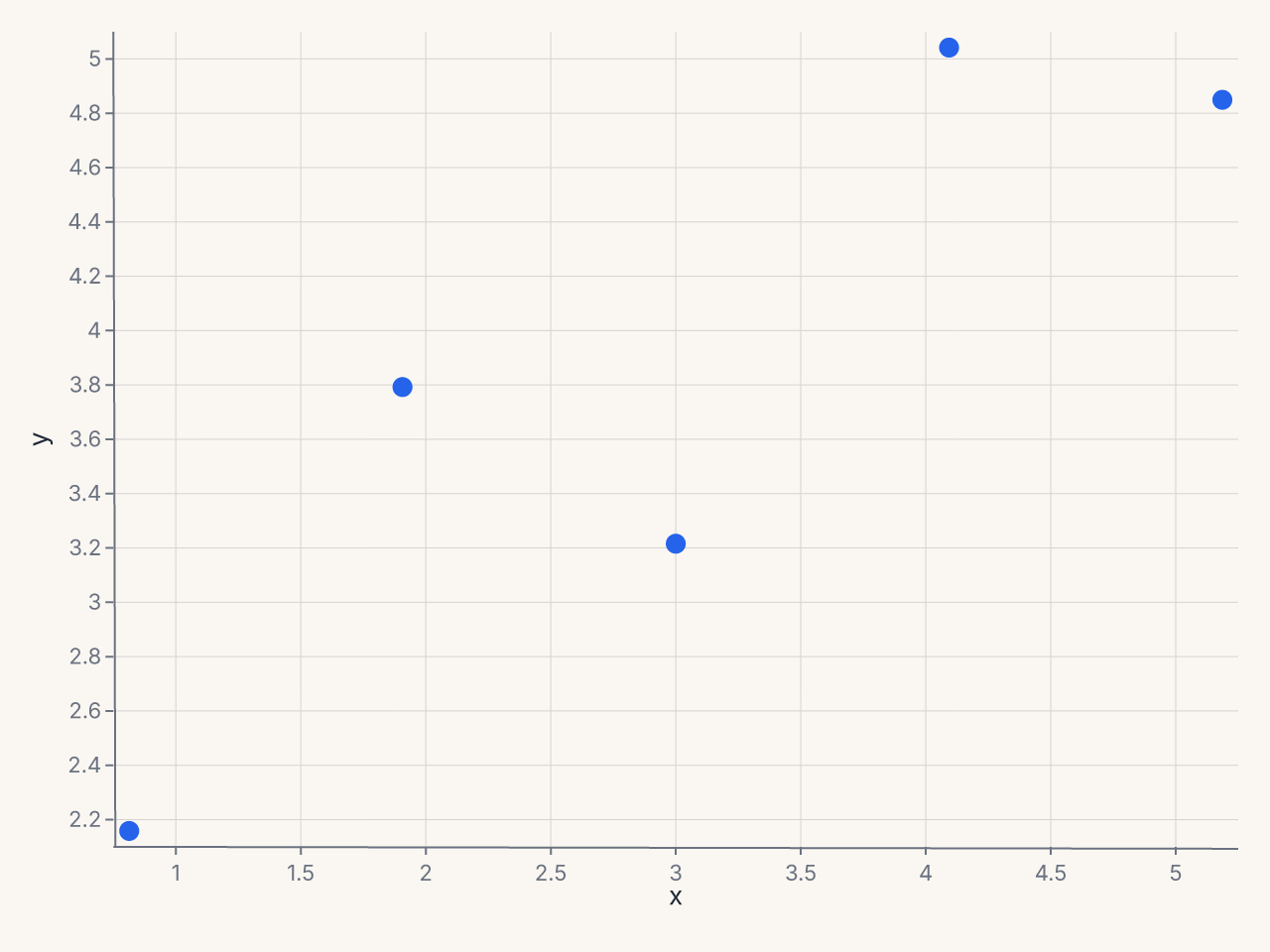
Example
import ferrum as fm
import polars as pl

df = pl.DataFrame({
    "x": [1, 2, 3, 4, 5],
    "y": [2.1, 3.8, 3.2, 5.1, 4.9],
})

chart = (
    fm.Chart(df)
    .mark_point(size=80)
    .encode(x="x:Q", y="y:Q")
    # Force the rotation via override. This path has a typed equivalent
    # (.configure_axis(label_angle=...)), so it also emits a DeprecationWarning
    # steering you there — prefer the typed method for paths that have one.
    .override(x_axis_label_angle=-30)
)
Reporting gaps
If you find yourself using .override() for something that should be in the typed
surface, please open an issue. The goal is that override is never needed for any common
customization.